
The Gold Standard
DEXA Body Composition Analysis
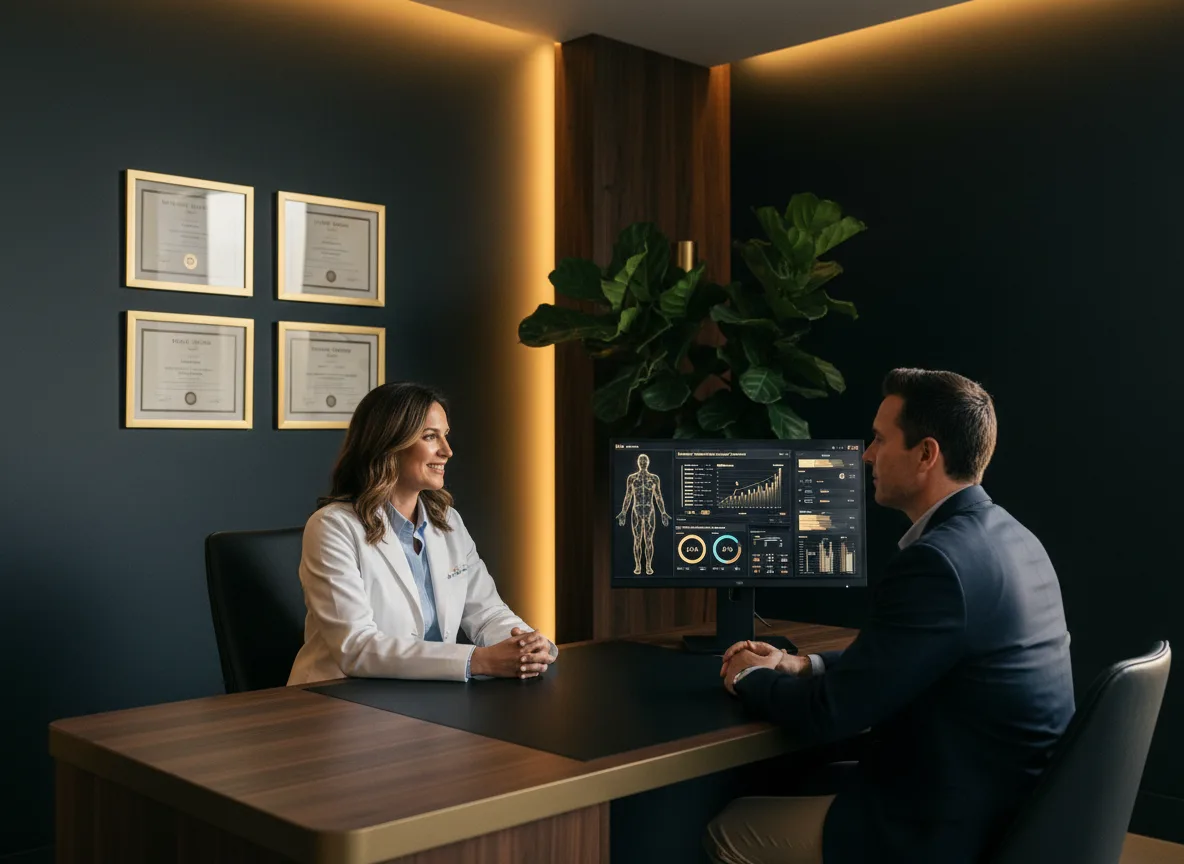
Under two minutes on our HOLOGIC Horizon-A separates your weight into fat, lean tissue, and bone — measured directly and region by region, on the same class of instrument osteoporosis clinics use. You leave with a full visual report and a specialist who walks you through it.
Comprehensive Analysis
What does a DEXA scan measure?
The whole-body pass reports total mass, body fat percentage, lean mass, fat mass, an estimate of visceral fat and the android/gynoid ratio — each broken out by region rather than given as one number. Bone mineral density with T-Score and Z-Score comes from the separate spine, hip and forearm protocols run in the same appointment.
Total Mass
Everything the scanner accounts for — tissue, skeleton, and body water combined. Your reference point for every scan that follows.
Body Fat %
How much of your total mass is fat tissue. The number a bathroom scale can only guess at.
Lean Mass
Muscle, organs, and connective tissue — everything working for you that is neither fat nor bone. The number to protect while losing weight.
Fat Mass
Fat in pounds rather than percent. Useful when your weight shifts and you need to know which tissue actually moved.
Visceral Fat
The fat wrapped around your abdominal organs — invisible from the outside and closely tied to cardiac and metabolic risk. Reported as an estimate derived from the abdominal region.
Bone Density
How much mineral your skeleton holds per square centimeter. Measured at the lumbar spine, hip, or forearm — the sites that carry clinical meaning.
Android/Gynoid Ratio
How your fat divides between the abdomen (android) and hips and thighs (gynoid). A useful way to see where fat sits, though its standalone clinical value is still debated.
T-Score
Your bone density against a healthy young adult reference. The value clinicians use to classify osteopenia and osteoporosis in postmenopausal women and men over 50.
Z-Score
Your bone density against others of your own age and sex. This is the relevant figure before menopause, for men under 50, and for anyone under 20.
One limit worth knowing before you book: a T-Score only carries diagnostic meaning when it comes from the lumbar spine, total hip, femoral neck or 33% radius — never from the whole-body pass. Before menopause, for men under 50 and for anyone under 20, the Z-Score is the figure that applies instead. Both rules come from the ISCD Official Positions, and they are why this studio runs the dedicated spine and hip protocols rather than reading bone off the body-composition scan.
Beyond Body Composition
What Else the Scanner Can Do
Our HOLOGIC Horizon-A is licensed for a set of clinical assessments most body-scan studios do not offer. Which of these apply depends on your age and history — we go through that with you.
FRAX Fracture Risk
Combines your bone density with personal risk factors into a single figure: how likely a fracture is over the next ten years. The model was developed by the WHO and sits in treatment guidelines worldwide. Applies from age 40.
Aortic Calcification
The same image that shows your spine also reveals whether calcium has built up in the abdominal aorta — an early sign of arterial hardening. No extra scan, no extra radiation. In pooled data across 36,000 people, pronounced deposits carried roughly double the cardiovascular risk.
Vertebral Fracture Assessment
Spinal fractures often happen without a fall and without pain, so many people never know. A ten-second lateral image makes them visible at a small fraction of the radiation of a conventional spine X-ray.
Hip Structure Analysis
Looks past density to the architecture of the femoral neck — cross-section, cortical thickness, leverage. Two people with identical bone density can have differently resilient bone.
Dual Hip
Both hips in one pass. Classification uses the weaker of the two, so scanning only one side misses it half the time. For tracking, averaging both improves reliability.
Pediatric Analysis
Children and adolescents need their own reference data — an adult yardstick misleads systematically. We run age-appropriate analysis against the BMDCS database for spine, hip, forearm, and whole body.
Least Significant Change
The quiet one that matters most on a repeat visit: is the change since your last scan real, or is it measurement noise? Without this figure a trend cannot be read honestly.
These assessments produce measurements and images. Interpreting them is a physician's task — we provide the data and, where it matters, tell you it is worth discussing with your doctor. In California that division is not a house rule but settled in an Attorney General opinion.
Why Choose DEXA
Why DEXA, not an estimate
Region by region
BMI knows your height and weight. Calipers pinch a few spots. DEXA measures each part of you separately — left arm against right, trunk against limbs.
The fat you cannot see
Visceral fat sits around your organs and shows up on no mirror and no scale. An estimate of it is one of the few numbers on metabolic health you can follow from scan to scan.
Comparable across years
Because the measurement is physical rather than estimated, two scans months apart are genuinely comparable. Your dashboard plots every one of them.
How it works
Two X-ray energies pass through you at a small fraction of a chest film's dose. The difference in how each is absorbed is what separates fat from muscle from bone.
Who Is DEXA For?
Who gets the most out of a DEXA scan?
Four groups, and what separates them is not fitness level but whether the result would change a decision: athletes checking what a training block actually built, anyone losing weight who needs to know which tissue went, people watching bone after menopause or on long-term medication, and those tracking visceral fat across years.
Athletes & Fitness
Track lean mass gains, spot left-right imbalances, and see whether a training block built muscle or only added weight. DEXA is the measurement class professional sports programs run on.
Weight Management
Go beyond the scale. Understand exactly how much fat you're losing and muscle you're gaining. DEXA shows the full picture that BMI and weight alone cannot.
Bone Health & Fracture Risk
Bone density at the spine and hip, a ten-year fracture risk estimate, and a lateral image that reveals silent vertebral fractures — the full clinical picture, not just a number.
Longevity & Anti-Aging
Track visceral fat, muscle retention, bone density, and arterial calcification as you age. Proactive data for those focused on healthspan, not just lifespan.
HOLOGIC DEXA technology is trusted by NFL, NBA, and MLB teams, leading hospitals, university athletic programs, and research institutions worldwide.
Before Your Visit
How should you prepare for a DEXA scan?
Wear something without metal, skip food for the two hours beforehand, empty your bladder on arrival, and take no calcium supplements in the 24 hours before your appointment. None of it is onerous, and the point of all four is the same: hold the conditions steady so the next scan is comparable to this one.
Men: athletic shorts + t-shirt. Women: yoga pants + sports bra. No zippers, belts, or underwire.
Food in your stomach can slightly affect readings. Water is fine.
A full bladder adds water weight that can skew results.
Calcium can interfere with bone density measurements.
Same fasting state, hydration level, and time of day for the most accurate comparisons.
You'll lie flat and fully clothed while the arm passes over your body. Completely painless.
We walk you through every metric and help you understand what the numbers mean for your health.
Safe. Painless. Proven.
A whole-body scan delivers about 3 µSv — less than a single day of natural background radiation, and a fraction of a transcontinental flight.
That is low enough to repeat several times a year. The figure follows the effective-dose method published by Blake and colleagues in Bone (2006), which is what manufacturers' dose tables are built on. We do not scan during pregnancy.
Where These Figures Come From
Sources
Scan times, radiation dose, the limits of a T-Score and the division of labour between technician and physician are all published elsewhere. These are the documents behind the numbers on this page.
- HOLOGIC Horizon DXA system
The manufacturer's specification for the model this studio runs.
- FDA 510(k) K072847 — APEX indications for use
What the scanner's software is cleared to report, and what it is not.
- ISCD Official Positions 2023
Which skeletal sites yield a diagnostically usable T-Score, and when the Z-Score applies instead.
- Blake et al., Bone 38 (2006) 935–942
The effective-dose method the radiation figures for DXA examinations rest on.
- Prognostic value of abdominal aortic calcification, JAHA 2021
Pooled results from 52 studies and 36,092 people on what aortic calcification predicts.
- California Attorney General Opinion 08-803
Why reading a radiological image is the practice of medicine in California.
Have Questions?
Frequently Asked Questions
What does a DEXA scan actually measure?
Dual-Energy X-ray Absorptiometry, abbreviated DEXA, exploits one physical fact: fat, muscle and the skeleton attenuate low- and high-energy X-rays by different amounts. Both beams pass through you, the two attenuation profiles are compared, and the mass of each tissue drops out of that comparison — region by region rather than as a single whole-body figure. Osteoporosis clinics run this same class of instrument, which is why a reading taken today still lines up against one taken years from now.
How accurate is a DEXA scan compared to a smart scale?
A smart scale sends a small current through your body and infers composition from the resistance it meets. That inference shifts with how much water you drank, what you ate, and which device you stepped on. DEXA does not infer anything — it measures tissue directly by X-ray attenuation, which is why it is the reference standard clinical studies validate other methods against.
How long does the appointment take?
The whole-body scan runs under 2 minutes with you lying still and fully clothed; spine and hip scans take about ten seconds each. Plan 30 minutes in total — the rest is a specialist going through your report with you, metric by metric, so you leave knowing what each number means for your situation.
What should I do before my scan?
Leave metal at home: no zippers, belts, or underwire. Athletic shorts and a t-shirt, or leggings and a sports bra, work well. Skip food for two hours beforehand, use the restroom on arrival, and hold off on calcium supplements for a day. If you intend to scan again later, repeat the same conditions each time — same time of day, same fasting state. That is what makes two scans genuinely comparable rather than merely similar.
Is the radiation exposure a concern?
No. A whole-body scan delivers about 3 µSv — less than a single day of natural background radiation, and a fraction of a transcontinental flight. That is low enough to repeat several times a year without accumulating meaningful exposure. We do not scan during pregnancy.
How often is it worth scanning?
Body composition moves slowly, so scanning too often mostly measures noise. Every three to six months captures real change for most people. If you are in an active training block or a deliberate weight-loss phase, every eight to twelve weeks makes sense. Start with a baseline, then scan on a rhythm that matches how fast you expect things to move.
Who gets the most out of a DEXA scan?
Anyone whose decisions would change based on the answer. Athletes checking whether a training block built muscle or just added weight. People on GLP-1 medication or in a calorie deficit, where the risk is losing lean mass alongside fat. Women after menopause, when bone loss accelerates quietly. And anyone who has been told their BMI puts them in a category that does not match how they look or feel.
What do I walk out with?
A full visual report covering body fat percentage, lean mass, fat mass, estimated visceral fat, bone mineral density with T-Score and Z-Score, android/gynoid distribution, and a left-versus-right breakdown by region. Where clinically relevant it also carries a ten-year fracture risk estimate and a vertebral fracture assessment. All of it stays in your private dashboard, so every later scan lines up against this one.
Start with a baseline
Every scan after this one measures against it. Book the first and find out where you actually stand.